
At the beginning of this year, we had the pleasure of welcoming Science Communication Specialist, Tansy, to be part of the SAW team. Having previously worked with us as a volunteer, Tansy got straight into the swing of things, and we couldn’t be happier with what we achieved in our three months together.
Here, we hand over to Tansy to tell us about her time working with the SAW Trust.
I began freelancing with SAW in December 2025 to help with their latest project: the Microbe Zoo. With previous experience in communications, visitor engagement and administration, I was eager to combine my Biological Sciences Degree with my passion for making STEM subjects inclusive and accessible… Thus, my journey as a Science Communication Specialist began!
How did I find the SAW Trust?
I was lucky enough to first work with Jenni (SAW Programme Manager) as a volunteer in the Science Tent at Latitude festival in the Summer of 2024 and 2025 where I got to cement my passion for science communication and engaging with kids. I found that the moment when a child’s face lights up, as a scientific concept finally makes sense to them, to be the most inspiring feeling, and knowing I had played a part in their understanding felt incredibly rewarding.
I swiftly sought work at both the Science Centre and Zoology Museum in Cambridge, where I was living at the time. Inspired to follow a career in Science Communication, combined with a calling to return to Norwich, I reached out to Jenni to see if she knew of anybody hiring in the sector.

Feeling satisfied that I’d finally put my LinkedIn account to use, to my delight, Jenni replied to say that she was indeed looking for some help with her current project, in collaboration with Sam Rowe at the Centre for Microbial Interactions, called The Microbe Zoo. The rest, as they say, is history!
The Microbe Zoo
Led by volunteer ‘zookeepers’, The Microbe Zoo is an immersive, interactive experience where visitors are guided through soil, gut and water environments to demonstrate the diverse world of microbes and the roles they play in our lives. It features incredible visuals, soundscapes and activities to engage any age with science and local microbiology research. My role was to support the planning and delivery of the Microbe Zoo.
It seemed a mammoth task at first. Our debut at the Norwich Science Festival was less than 3 months away and not only did we need to build the physical exhibition, but we had materials to plan and order, workshops to host, volunteers to co-ordinate, props to make and educational resources to create. Of course, this wasn’t a task for two – over the course of my time working on the Zoo we had the support of local artists, scientists, teachers, lecturers, colleagues at the John Innes Centre and beyond. Jenni’s enthusiasm and optimism for the project was infectious and (with a little planning and a lot of teamwork, creativity, adaptation, and some improvisation) I didn’t doubt the Microbe Zoo’s success for a second.
The Big Debut
The Norwich Science Festival 2026 came around in a flash and after five intense days of moving and building (and finishing!) the Microbe Zoo from PrimeYarc in Great Yarmouth to the Forum in Norwich, as well as squeezing in some volunteer training sessions, we finally opened our doors to the public.
The first few days were full-on, with the exhibit being far more in-demand than we had anticipated. Strong teamwork and communication were vital during this period of huge excitement with some challenging circumstances. For an exhibit that was in use by the public 7 hours a day for 9 days straight, it was inevitable that parts would break or occasionally fail – parts that were soon repaired and up and running again.
I am so proud of how the team (volunteers included!) came together and worked through every challenge that came our way. By the end of the week, the Zoo was running like clockwork.
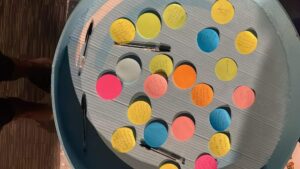
Although there are some improvements to be made from this first run, with over 900 individual pieces of glowing positive feedback, I think we can safely say the Microbe Zoo was a success.
What else did I get up to with the SAW Trust?
The list could be endless with knowledge I gained and lessons I learnt over the three months, but here are a few accomplishments throughout my time with the SAW Trust:
- Flexing my creative muscles. I made a series of props for the Microbe Zoo exhibition including giant foods to take through the gut tunnel, as well as a giant poo at the end of the gut tunnel! I tried to use materials we already had to hand (paper plates, pizza boxes, leftover foamex, stuffing from Jacques’ armchair for the giant poo…) but other resources such as specific fabrics or paints were bought. I learnt to adapt materials and methods to make props that are realistic, engaging and sturdy – who knew a giant petri dish could be made in so many ways! I can safely say I feel confident in my papier mâché capabilities after this project.
- Felt microbe workshops at Great Yarmouth Primary Academy (GYPA). We were met by some very bright and creative year 5 pupils at GYPA who got stuck into learning about microbes and gave a good go at sewing their very own felt-stuffed microbes. These microbes were added to the ‘gut tunnel’ section of the Microbe Zoo for display at Norwich Science Festival. I loved interacting with the kids and witnessing their enthusiasm for trying new things.

- Creating educational resources. I helped make zoo exhibit caption signs, information ‘petri-dishes’ and activity books – I learnt how to collaborate with others and used a variety of software to translate research-based science into accessible language for wider audiences.
- Volunteer management. The volunteers I worked with on the Microbe Zoo came from across the Norwich Research Park, ranging from undergrads to PhD students, to established research scientists. Our ‘zookeepers’ worked extremely hard engaging with the public during the festival, utilising their expertise and enthusiasm for science and the project, and were a dream to supervise. This experience taught me how to best manage worker time, co-ordinate breaks, communicate well and listen to and act on feedback quickly.
- Science Communication lecture at UEA. I supported Jenni in the delivery of her annual undergraduate lecture and workshop about the work of the SAW Trust and the importance of science communication in translating scientific research to a wider society. It was a surreal experience to support a lecture that I had sat in myself six years prior.

To say the role was diverse is an understatement! I learned how to be resilient, adapt under pressure, identify and utilise strengths of the team (and of my own) and appreciate the value of communicative teamwork.
My endless thanks to the SAW Trust (particularly Jenni Rant for sharing her passion for science communication and for taking a chance on me), Prof Anne Osbourn, Sam Rowe, fellow Microbe Zookeeper Ka Cheung, as well as Shannon, Sasha, Sami, Tim, Nat, Connor, Phil Archer from Norwich University of the Arts, the brilliant Microbe Zoo volunteers, researchers, artists at ‘Original Projects;’ and everyone I had the pleasure to work with over my 3 months with the SAW Trust. Best of luck to all with ongoing Microbe Zoo travels!
We wish Tansy all the best and look forward to working with her again in the future.
Main image: the Microbe Zoo team and volunteers ready to welcome the Norwich Science Festival visitors. From bottom left, Tansy, Jenni Rant, Sam Rowe, Ka Cheung and volunteer zoo keepers.